Concerned about primary care in BC? Learn more below.

Independent Health System Statistics
On Feb 9/2024, Adrian Dix released a statistics-laden update. As we've come to expect, while acknowledging that we still have some way to go, this painted a picture of primary care well on its way to recovery. And we know that statistics don't lie.
While titled New compensation model connects more people to primary care, it was more of a general primary care update, also touching on nurse practitioners, the Health Connect Registry, and other matters.
There is much good news in these statistics, especially compared to what would have happened had these initiatives not come to fruition. Unfortunately, the statistics don't tell the whole story, as I will illustrate below. This comes as no surprise to the millions struggling to access effective primary care in BC.
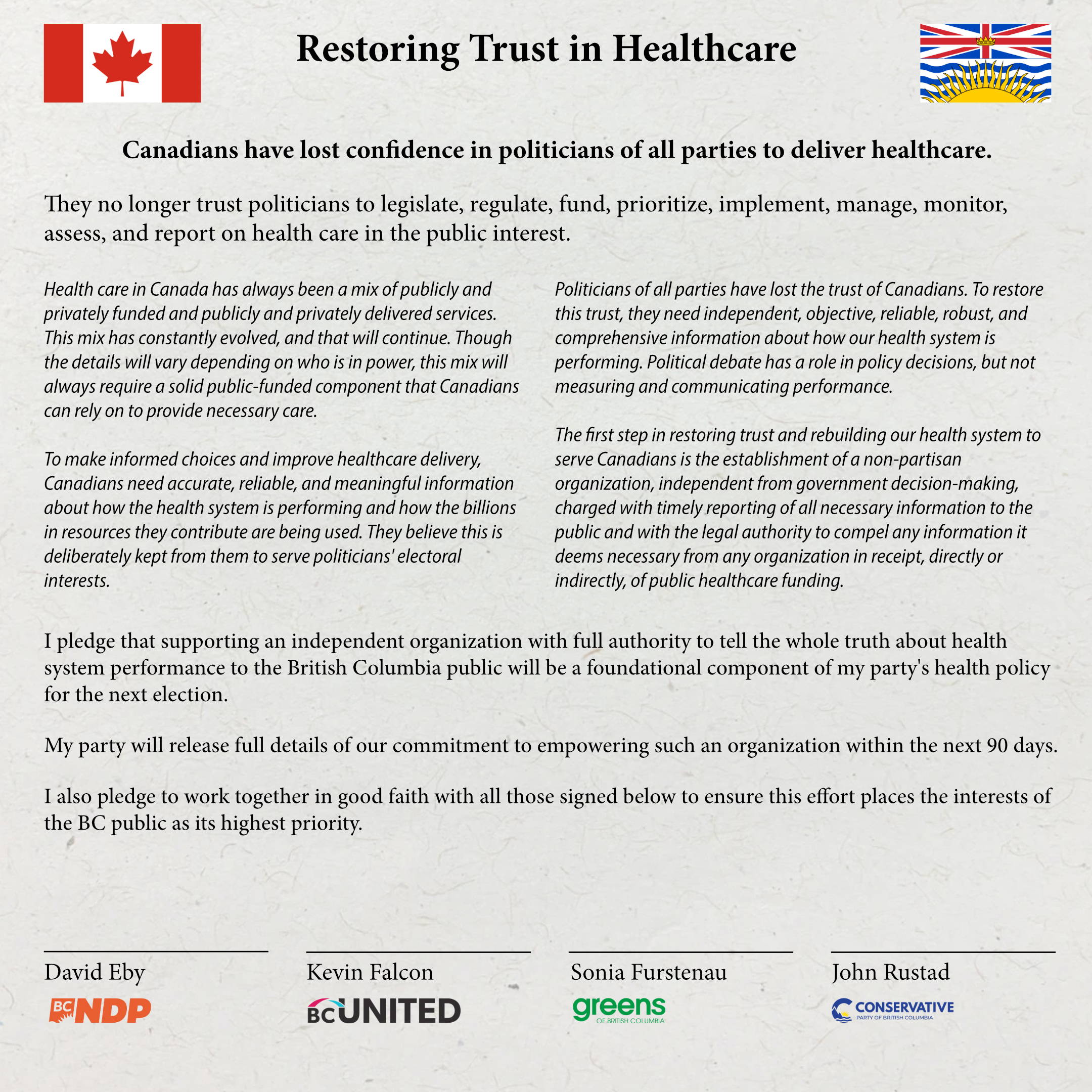
If government messaging is primarily for the purpose of pre-election marketing, the public deserves an independent source of information to remain informed about the actual state of the healthcare system. We all depend on that system for our health, and pay for it. Governments and health authorities are caretakers on our behalf. They need to act first in the public interest, not their own.
In what follows, I'll walk through the data described in Mr. Dix's update, look at what it infers, and talk about what is missing that would be needed to provide a full and accurate picture.
I don't have this missing data, so I can't make any conclusions about actual health system performance.
And that's really the point.
Overall performance
From the update:
"more people have access to primary care with 4,000 family physicians registered for the model in its first year helping expand the number of family physicians working in longitudinal primary care."
As of December 2023, there were approximately 5,000 family physicians in total working in longitudinal primary care, an increase of 708 or 16.5% from December 2022. In addition, there were 590 nurse practitioners working in primary care, an increase of 60 or 11.3% since December 2022 to December 2023."
| Claim | Inference | What's Missing |
|
"more people have access to primary care"
|
In absolute or relative terms, there are more people in BC who have a primary care provider now than (at some point) in the past.
|
- "Access" is too vague. Does it mean attachment?
- How many people (absolute, relative) have access now vs. how many had access at what point in the past?
- Is the comparison to a point in time, or something else? Does it cover all people, or just some?
- If LFP had not come in and family doctors had to rely on stagnant FFS rates, many would have left. Let's say 100 doctors stayed who otherwise wouldn't have. Assume each had a panel of 1000 patients. Those 100,000 patients would have lost their doctor but didn't. I can say, with respect to those people, that "more people have access to primary care" than would have.
- Bottom line: additional clarification and/or data is required to justify this claim
|
|
~5000 physicians doing longitudinal care vs. ~4300 a year ago
|
More longitudinal care is being provided by physicians
|
- The source of these statistics is unclear; by what measure is a family physician deemed to be providing longitudinal care?
- Most likely for statistical purposes, is it physicians who have billed G14070? This states that do provide longitudinal care in their practice, making them eligible for use of extra billing codes and the CLFP payment?
- If so, this doesn't require the physician's entire practice to be providing longitudinal care. In fact, there are no requirements about the amount of time physicians spend doing longitudinal care (so it could be a very small fraction) or the number of patients they provide longitudinal care.
- A better measure than number of physicians involved in (some) amount of primary care, would be FTEs spent in longitudinal care.
- Not mentioned is the approximately 2400 family physicians who provide very limited or no longitudinal care by whatever metric is being used (there were 7,393 registered family physicians as of Feb/2023, according to the CPSBC annual report)
- Bottom line: we know that more physicians, by some measure, are providing some longitudinal care, but we don't know how much time is spent and how many patients are served, and if that is more or less than a year ago
|
|
590 nurse practitioners in primary care vs. 530 a year ago
|
More nurse practitioners are following panels of patients
|
- Note this statistic says working in primary care not longitudinal primary care
- This could therefore include those working in episodic care such as provided by UPCCs. In fact, this seems likely, given we know much of the staffing in UPCCs is with NPs, and that they provide a limited amount of longitudinal care. We also know many NPs work for services like Telus Health which provide no longitudinal care.
- As with physicians, the number of personnel involved is not as accurate a measure as something like FTEs spent in longitudinal care.
- There is no mention of if all these NPs are providing care that is government-funded rather than patient-pay; unlike family physicians, where to date few operate outside of MSP, NPs cannot bill MSP. The government provides funding for many NP-led clinics so that patients do not have to pay. But there are also clinics opening where patients pay the cost of care directly.
- Bottom line: We don't know what those nurse practitioners are doing in primary care, including even how many are doing longitudinal care at all.
|
Patient Attachment
Notably absent from previous updates has been data about the number of patients needing primary care, instead of just data on the providers. Mr. Dix has faced considerable criticism over this omission, so I was glad to see it addressed in some fashion.
From the update:
"Through this program, these providers have attached more than 243,000 patients with an estimated 222,500 future attachments remaining before they reach the end of their contracts."
"As of Feb. 7, 2024, more than 50,000 people have been connected to primary care through the HCR."
"The new capacity created within B.C.’s primary-care system will support the 275,000 people who are now registered with the Health Connect Registry to attach to primary care."
| Claim | Inference | What's Missing |
"have attached 243,000"
"222,500 future attachments"
"50,000 people connected to primary care through the HCR"
|
All these people were not attached to a primary care provider before but now are.
|
- How many people were attached previously to another provider, became unattached, and then were attached again to someone else?
- This can happen for any number of reasons, including people moving, providers retiring or switching to a different model of practice, etc.
- How many people who were attached no longer are attached? What happens to these people? We repeatedly hear of people who waited years on the HCR, were attached, and then their doctor closes practice, leaving them unattached again.
- How many people became unattached (lost their providers)? Is it more or less than the number of attachments? By how much?
- Bottom line: we have a "gross" number of attachments, whereas we really need a "net" number of attachments
|
"275,000 people who are now registered with the Health Connect Registry"
|
Far less than a million people are looking for a primary care provider.
|
- I'm glad to see data on the number of people still on the registry! But I fear this will be used by Dix as a proxy for the number of people needing primary care to pretend that the problem is less severe than it is.
- We need to see data on how many people in total are not attached to primary care, not just those on the HCR.
- We need to know about geographic distribution, length of time people are on the registry, net numbers added or removed, etc.
- None of these statistics cover people who are nominally attached to primary care, but who continue to have very limited access (weeks or months to wait for appointments, etc.)
- Bottom line: we have very little data about how effective HCR is, and how it reflects the broader population who need access to primary care
|
Much More to Come
There are a great many more statistics included in this update, including about UPCCs, various "investments," team-based care, and more. I'll address several others in the near future.
What Needs to Happen
When it comes to sharing information about the performance of the health system, governments have a massive conflict of interest. We therefore end up with one-sided
marketing like Dix's primary care update.
We need to do a lot better, and that requires information coming from an independent party (imagine a CIHI, but with teeth). Unfortunately, this will require political action, either provincial or federal. Here's one idea of what that might entail…